London Fashion Week | Fashion Industry | 10 October 2026
Fashion is celebrated for its visual impact, but clothing is also experienced through texture, movement, sound and emotion. At London Fashion Week, designer Chet Lo and the Making Fashion Accessible initiative demonstrated how a runway presentation can welcome blind and partially sighted guests without compromising its creative vision.
Fashion is more than something we see
A fashion show is traditionally built around visual spectacle.
Models move along the runway while audiences observe the colours, silhouettes, fabrics and details of a new collection.
But this familiar format raises an important question: what happens when someone cannot see the clothes clearly—or cannot see them at all?
At London Fashion Week in February 2026, designer Chet Lo offered one possible answer.
Working with the Making Fashion Accessible initiative, his presentation introduced opportunities for blind and partially sighted guests to explore garments through touch and follow the runway through spoken descriptions.
The experience demonstrated that fashion’s creative language can extend beyond the visual.
Inside Chet Lo’s accessible runway
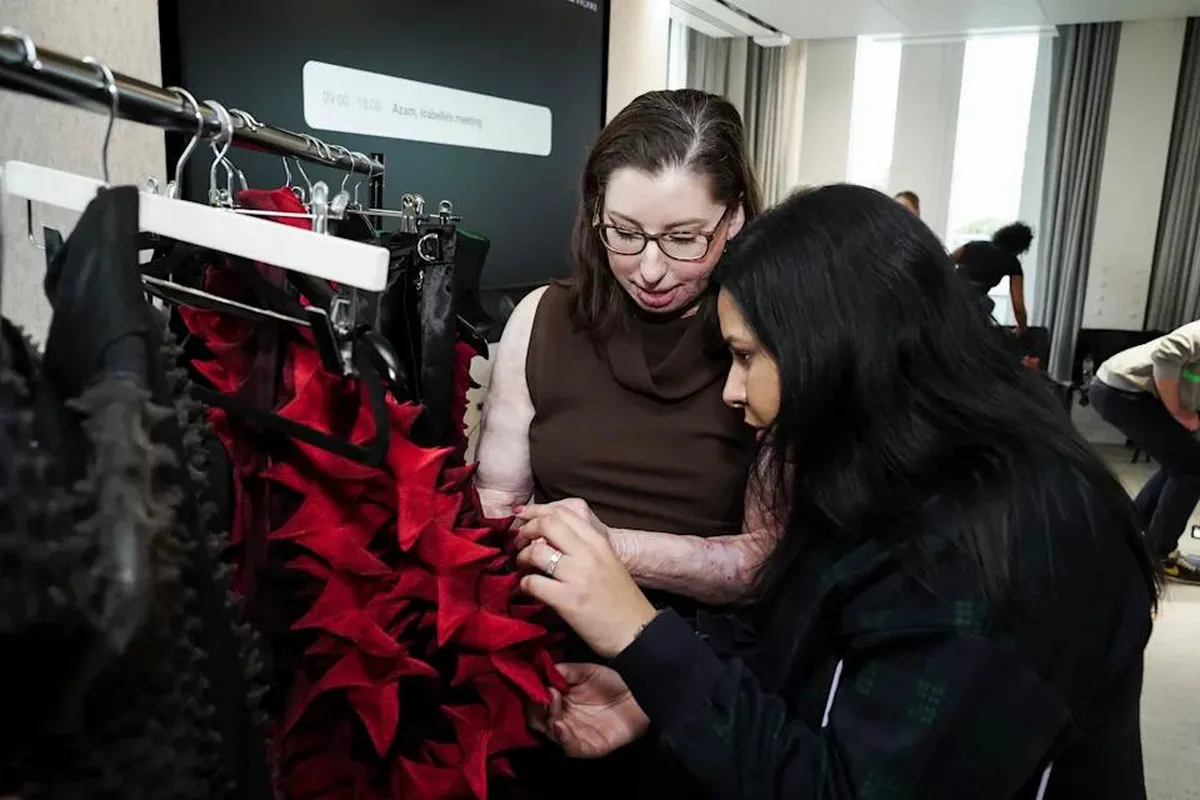
Before Chet Lo’s Autumn/Winter 2026 presentation, guests with sight loss were invited to explore pieces from his Night Market collection.
The experience included a guided touch tour, during which participants could handle garments and learn about their construction.
The collection’s distinctive textures made it particularly suitable for tactile exploration.
Guests encountered spiked knitwear, fitted dresses and decorative surfaces that communicated information through touch as well as appearance.
During the runway presentation, attendees received headphones providing audio descriptions of the looks.
Fabric swatch booklets offered another connection to the garments, allowing guests to feel materials while listening to information about what appeared on the catwalk.
These features were not intended to recreate sight.
They provided different ways to understand the collection’s design, materials and movement.
The people behind the initiative
Making Fashion Accessible is an initiative developed by Hair & Care, a non-profit organisation founded by hairstylist Anna Cofone in 2019.
Cofone’s experience growing up with a father who was blind helped shape her understanding of how appearance, grooming and personal style contribute to independence and identity.
The organisation initially focused on hair and self-care workshops for blind and partially sighted women.
It later expanded its work into fashion events, introducing sensory experiences intended to make runway presentations more inclusive.
Chet Lo became one of its early designer collaborators.
The initiative has also worked with other fashion names, including Roksanda and Erdem.
Its approach is practical: work with designers and event organisers to identify barriers, then introduce alternative ways for guests to participate.
Why touch makes a difference
Clothing has physical qualities that photography cannot fully communicate.
The weight of a fabric, the structure of a seam, the softness of a lining and the movement of a garment all contribute to how it is experienced.
For a guest with limited or no usable sight, these details can become especially important.
A touch tour allows someone to explore the construction of clothing directly.
Fabric swatches can communicate texture and material differences while a runway presentation is taking place.
Audio description can provide information about colour, silhouette, styling and movement that may otherwise be inaccessible.
Together, these elements create a more complete understanding of the designer’s work.
They also remind the fashion industry that the experience of clothing has never been exclusively visual.
Listening to the audience
The Guardian’s March photo essay documented the experiences of several guests at Chet Lo’s presentation.
Jane Manley, a data analyst at the Royal National Institute of Blind People, described combining the atmosphere of the room with fabric swatches and audio description to build an understanding of the runway looks.
Model and beautician Livi Deane explained how tactile materials helped her appreciate details that would otherwise be difficult to distinguish.
Disability advocate and model Catrin Pugh also discussed the value of experiencing a show through multiple senses.
Their perspectives highlight an essential principle of accessibility.
An effective experience should be developed around the needs of the people using it, rather than assumptions about what those people may enjoy.
Fashion is connected with confidence, self-expression and identity regardless of visual ability.
Accessibility belongs beyond fashion week
An accessible runway presentation is an important starting point, but the challenge extends much further.
Fashion websites frequently depend on photographs with little meaningful description.
A product page may identify a garment as a dress without explaining its shape, fabric, fastening or distinctive features.
For shoppers using screen readers, this can make independent purchasing unnecessarily difficult.
More informative image descriptions, accessible navigation and clear garment information can help remove those barriers.
Physical retail environments present different challenges.
Staff training, accessible changing rooms, practical product labels and opportunities to examine materials can all influence the shopping experience.
These improvements should be understood as part of good customer service rather than occasional special arrangements.
Representation and participation
The fashion industry’s conversation about inclusion often concentrates on who appears on the runway.
That remains important.
But inclusion also concerns who can attend shows, participate in creative work, access fashion education and engage with brands.
Blind and partially sighted people are not simply an audience requiring assistance.
They include models, stylists, creators, campaigners, professionals and consumers with their own tastes and creative perspectives.
Making fashion more accessible can therefore enrich the industry rather than merely accommodate a particular group.
It creates opportunities for different experiences and forms of expertise to influence how fashion is presented.
What other designers can learn
Chet Lo’s collaboration offers practical lessons for brands and event organisers.
Audio description can be prepared alongside the development of a collection.
Fabric samples can be organised to help guests understand key materials.
Touch tours can introduce garments before a presentation, while accessible information can be made available through digital channels.
None of these approaches eliminates the need to consult disabled participants about what works for them.
Accessibility is not a single feature that can be added once and considered complete.
It is an ongoing process of listening, adapting and improving.
The wider fashion industry has an opportunity to build these practices into event planning rather than treating them as exceptional additions.
A broader vision of fashion
The significance of Chet Lo’s accessible runway lies in its challenge to a familiar assumption: that fashion must be seen to be fully appreciated.
Clothing communicates through more than appearance.
Its materials, construction, movement and emotional meaning are part of the experience.
By combining touch tours, audio description and tactile information, Making Fashion Accessible demonstrated how designers can share more of that experience with a wider audience.
The initiative also offers a reminder that creative excellence and accessibility are not opposing ambitions.
La Modelle’s perspective: Fashion becomes more meaningful when more people can participate in it. Chet Lo’s collaboration with Making Fashion Accessible shows that thoughtful design extends beyond the clothes themselves to the way collections are presented, described and experienced. A truly modern fashion industry should make room for different ways of engaging with style.