Fashion News | London Fashion Week | 10 October 2026
Burberry’s Spring/Summer 2027 collection brought together two distinctive expressions of British design: the house’s unmistakable check and Celia Birtwell’s free-spirited prints. Under Daniel Lee, the collaboration offered a more playful interpretation of luxury, grounded in craftsmanship, individuality and creative heritage.
When British heritage meets creative freedom
At London Fashion Week on 21 September 2026, Burberry presented a collection that looked beyond the polished conventions of traditional luxury.
Creative director Daniel Lee collaborated with textile designer Celia Birtwell, whose expressive patterns helped define the visual culture of British fashion during the late 1960s and early 1970s.
The partnership brought together two very different design languages.
Burberry is associated with structure, outerwear and its instantly recognisable check. Birtwell’s work embraces fluid lines, floral motifs, hand-drawn characters and an instinctive sense of movement.
Rather than allowing one aesthetic to dominate the other, the collection explored what happens when established symbols are given room to evolve.
The result was a more relaxed and expressive vision of British luxury.
Celia Birtwell’s lasting influence
Celia Birtwell occupies a distinctive place in British fashion history.
Her textile designs became closely associated with Ossie Clark, whose clothing captured the romantic, bohemian spirit of London in the late 1960s and early 1970s.
Her cultural significance also extends into the visual arts. Birtwell appeared alongside Clark in David Hockney’s celebrated painting Mr and Mrs Clark and Percy.
Decades later, her work remains recognisable for its expressive drawing, playful colour and refusal to feel overly controlled.
For Burberry, that heritage offered something different from a conventional collaboration built around logos or celebrity recognition.
Birtwell contributed an individual artistic vocabulary capable of transforming familiar house codes.
Her involvement also demonstrated how fashion can connect generations without reducing its history to nostalgia.
Reinventing the Burberry check
One of the collection’s most interesting ideas was the treatment of Burberry’s signature check.
The pattern is among the most recognisable visual identities in British fashion. Its strength lies in consistency, but that same familiarity can make reinvention difficult.
Birtwell’s drawings introduced a softer, less regimented approach.
According to Burberry’s official collection notes, the check was interpreted through gingham and stripes, while faces and floral motifs interrupted the usual graphic structure.
The resulting designs suggested something more personal than a perfectly repeated pattern.
That distinction matters in contemporary luxury.
As fashion becomes increasingly polished through digital presentation and tightly controlled branding, visible individuality can offer a different kind of appeal.
Here, the irregularity of the artist’s hand became part of the collection’s character.
The return of playful fashion
Floral embroidery, expressive patterns and softened silhouettes gave the collection an optimistic mood.
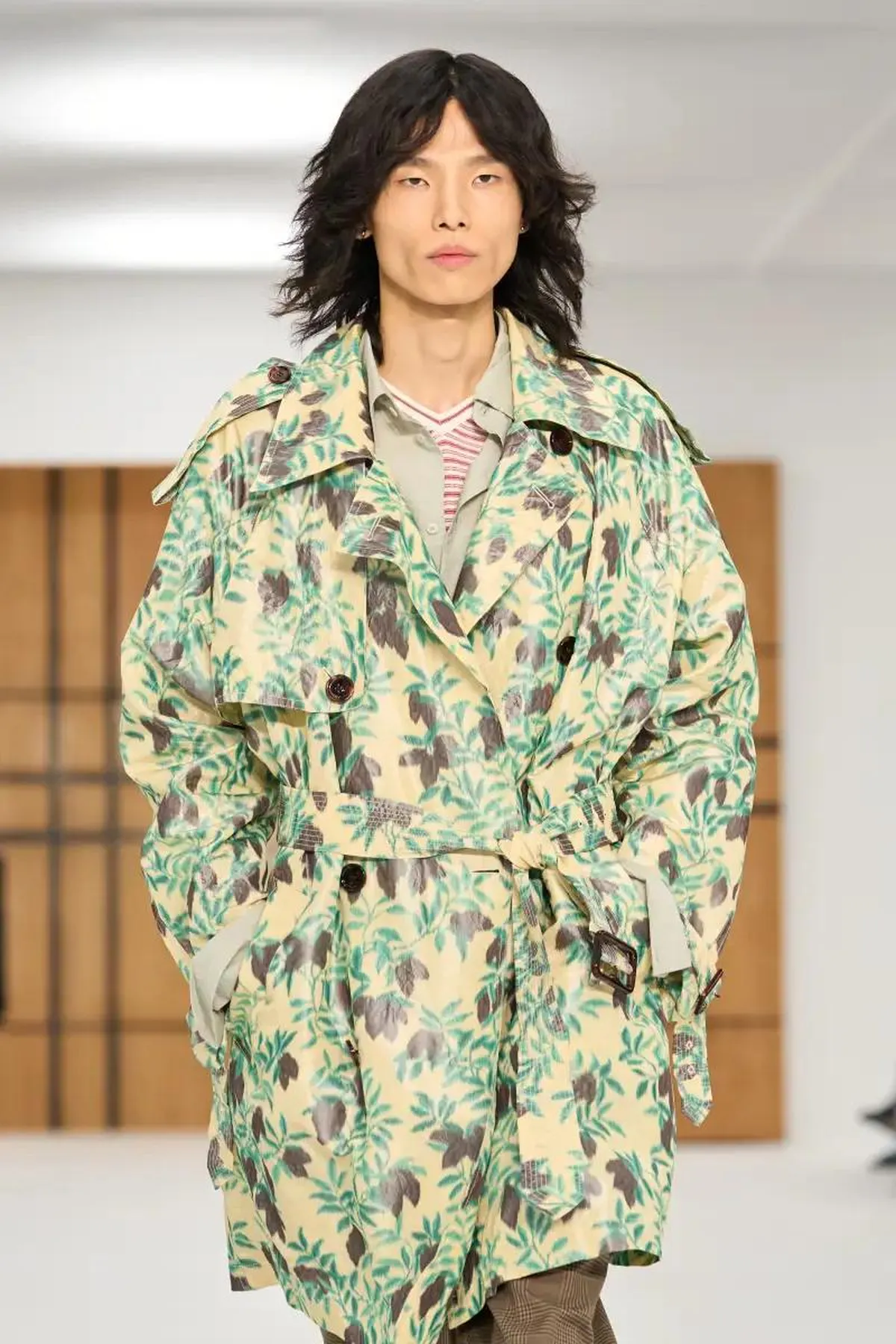
Reuters documented trench coats decorated with botanical designs, patterned tailoring and a mixture of delicate fabrics with brighter colour combinations.
These elements were not confined to womenswear.
Menswear also incorporated expressive styling, including relaxed proportions and influences associated with contemporary street fashion.
The collection moved between the familiar and the unexpected: structured outerwear alongside lighter materials, classic British references alongside playful decorative details.
It suggested that luxury does not always need to communicate seriousness.
Colour, humour and individuality can be equally powerful expressions of design confidence.
Daniel Lee’s evolving Burberry
Since becoming Burberry’s chief creative officer, Daniel Lee has worked with the brand’s British identity while reconsidering how that identity can speak to contemporary audiences.
The trench coat remains central to this conversation.
Originally valued for its practical construction, the trench has developed into one of fashion’s enduring wardrobe signatures.
For Spring/Summer 2027, Lee continued exploring its possibilities through lighter fabrics, altered proportions and decorative finishes.
These changes allowed Burberry’s established outerwear expertise to remain visible without making every design feel like a reproduction of the past.
The collaboration with Birtwell added another dimension.
Instead of relying solely on the authority of the archive, the collection introduced the personality of a living artist whose work belongs to a different chapter of British fashion history.
That combination gave the presentation a sense of continuity without creative stagnation.
Fashion as a cultural conversation
The show took place at Chelsea College of Arts in London, reinforcing its connection to the city’s artistic community.
Its casting and styling also reflected the meeting
Burberry and Celia Birtwell: A New Spirit of British Fashion
Fashion News | London Fashion Week | 10 October 2026
Burberry’s Spring/Summer 2027 collection brought together two distinctive expressions of British design: the house’s unmistakable check and Celia Birtwell’s free-spirited prints. Under Daniel Lee, the collaboration offered a more playful interpretation of luxury, grounded in craftsmanship, individuality and creative heritage.
When British heritage meets creative freedom
At London Fashion Week on 21 September 2026, Burberry presented a collection that looked beyond the polished conventions of traditional luxury.
Creative director Daniel Lee collaborated with textile designer Celia Birtwell, whose expressive patterns helped define the visual culture of British fashion during the late 1960s and early 1970s.
The partnership brought together two very different design languages.
Burberry is associated with structure, outerwear and its instantly recognisable check. Birtwell’s work embraces fluid lines, floral motifs, hand-drawn characters and an instinctive sense of movement.
Rather than allowing one aesthetic to dominate the other, the collection explored what happens when established symbols are given room to evolve.
The result was a more relaxed and expressive vision of British luxury.
Celia Birtwell’s lasting influence
Celia Birtwell occupies a distinctive place in British fashion history.
Her textile designs became closely associated with Ossie Clark, whose clothing captured the romantic, bohemian spirit of London in the late 1960s and early 1970s.
Her cultural significance also extends into the visual arts. Birtwell appeared alongside Clark in David Hockney’s celebrated painting Mr and Mrs Clark and Percy.
Decades later, her work remains recognisable for its expressive drawing, playful colour and refusal to feel overly controlled.
For Burberry, that heritage offered something different from a conventional collaboration built around logos or celebrity recognition.
Birtwell contributed an individual artistic vocabulary capable of transforming familiar house codes.
Her involvement also demonstrated how fashion can connect generations without reducing its history to nostalgia.
Reinventing the Burberry check
One of the collection’s most interesting ideas was the treatment of Burberry’s signature check.
The pattern is among the most recognisable visual identities in British fashion. Its strength lies in consistency, but that same familiarity can make reinvention difficult.
Birtwell’s drawings introduced a softer, less regimented approach.
According to Burberry’s official collection notes, the check was interpreted through gingham and stripes, while faces and floral motifs interrupted the usual graphic structure.
The resulting designs suggested something more personal than a perfectly repeated pattern.
That distinction matters in contemporary luxury.
As fashion becomes increasingly polished through digital presentation and tightly controlled branding, visible individuality can offer a different kind of appeal.
Here, the irregularity of the artist’s hand became part of the collection’s character.
The return of playful fashion
Floral embroidery, expressive patterns and softened silhouettes gave the collection an optimistic mood.
Reuters documented trench coats decorated with botanical designs, patterned tailoring and a mixture of delicate fabrics with brighter colour combinations.
These elements were not confined to womenswear.
Menswear also incorporated expressive styling, including relaxed proportions and influences associated with contemporary street fashion.
The collection moved between the familiar and the unexpected: structured outerwear alongside lighter materials, classic British references alongside playful decorative details.
It suggested that luxury does not always need to communicate seriousness.
Colour, humour and individuality can be equally powerful expressions of design confidence.
Daniel Lee’s evolving Burberry
Since becoming Burberry’s chief creative officer, Daniel Lee has worked with the brand’s British identity while reconsidering how that identity can speak to contemporary audiences.
The trench coat remains central to this conversation.
Originally valued for its practical construction, the trench has developed into one of fashion’s enduring wardrobe signatures.
For Spring/Summer 2027, Lee continued exploring its possibilities through lighter fabrics, altered proportions and decorative finishes.
These changes allowed Burberry’s established outerwear expertise to remain visible without making every design feel like a reproduction of the past.
The collaboration with Birtwell added another dimension.
Instead of relying solely on the authority of the archive, the collection introduced the personality of a living artist whose work belongs to a different chapter of British fashion history.
That combination gave the presentation a sense of continuity without creative stagnation.
Fashion as a cultural conversation
The show took place at Chelsea College of Arts in London, reinforcing its connection to the city’s artistic community.
Its casting and styling also reflected the meeting